


Investing across global credit markets, including investment grade, high yield, emerging market corporates and securitised assets, the strategy seeks to diversify sources of return and manage risk through active allocation and issuer selection.
Why now
Higher yields and increased dispersion across global credit markets are enhancing the opportunity set for active, multi-sector credit strategies.
|
Key Takeaways
|
Global diversified credit (GDC) is an actively managed fixed income approach that allocates across multiple credit sectors (including investment grade, high yield, emerging markets and securitised assets) to access a broader opportunity set and diversify risk exposures.
Why Allianz Global Diversified Credit
Diversification across credit sectors and regions aims to reduce reliance on any single source of return.
- Flexible allocation across public credit markets globally (HY, IG, securitised, EM, financials)
- Limits concentration risk vs. single-sector strategies
- Designed to smooth returns across cycles
Allianz Global Diversified Credit: Breaking asset class barriers
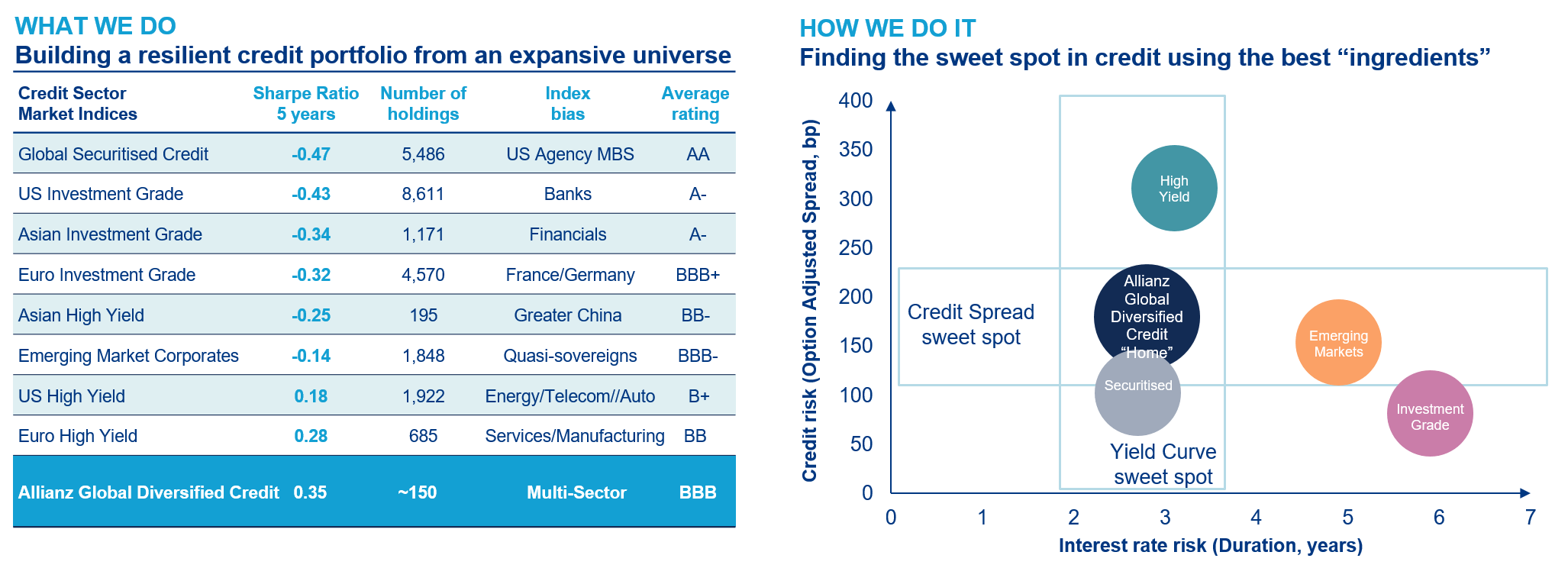
Source: Allianz Global Investors, Bloomberg; Bloomberg, ICE BofA and JP Morgan indices, data as at 31 December 2025. 1 We calculate the Sharpe Ratio by dividing monthly excess returns above a “risk-free rate” by the standard deviation of the excess returns. This provides an indication how efficiently a portfolio return rewards investors for the portfolio volatility they experience. The higher the Sharpe Ratio, the better the historical risk-adjusted performance. For the risk-free rates, for the USD market indices we use the Bloomberg US Generic Government 3-Month Index, for the EUR market indices we use the Bloomberg Generic Germany 3-month Government Bond Index, and for Allianz Global Diversified Credit we use the ICE BofA US 3-Month Treasury Bill Index. The Global Securitised Credit Sharpe Ratio is calculated on USD hedged basis, all others in unhedged USD or EUR. Asian and emerging-market indices represent USD denominated bonds. Data gross of fees. Individual costs such as fees, commissions and other charges have not been taken into consideration and would have a negative impact on the performance if they were included. Data is for the Rogge Global Multi-Asset Credit Fund - USD Hedged Shares from 05.12.2014 (inception date) to 30.10.2016 and the Allianz Global Diversified Credit Fund - USD Hedged Shares from 31.10.2016 to 31.12.2025. Note that the Rogge Global Multi-Asset Credit Fund was renamed as the Allianz Global Diversified Credit Fund on 31 October 2016. All data and information are illustrative only, not indicative of future allocation, and subject to change. Past performance does not predict future returns. A performance of the strategy is not guaranteed and losses remain possible. Diversification does not guarantee a profit or protect against losses.
Dynamic positioning across sectors and regions, combining macro insights with issuer-level research.
- Combines:
- Top-down macro views (rates, spreads, liquidity)
- Bottom-up issuer research - Enables dynamic rotation across regions and sectors
- Focuses on relative value rather than static exposures
Allianz Global Diversified Credit: Investment process
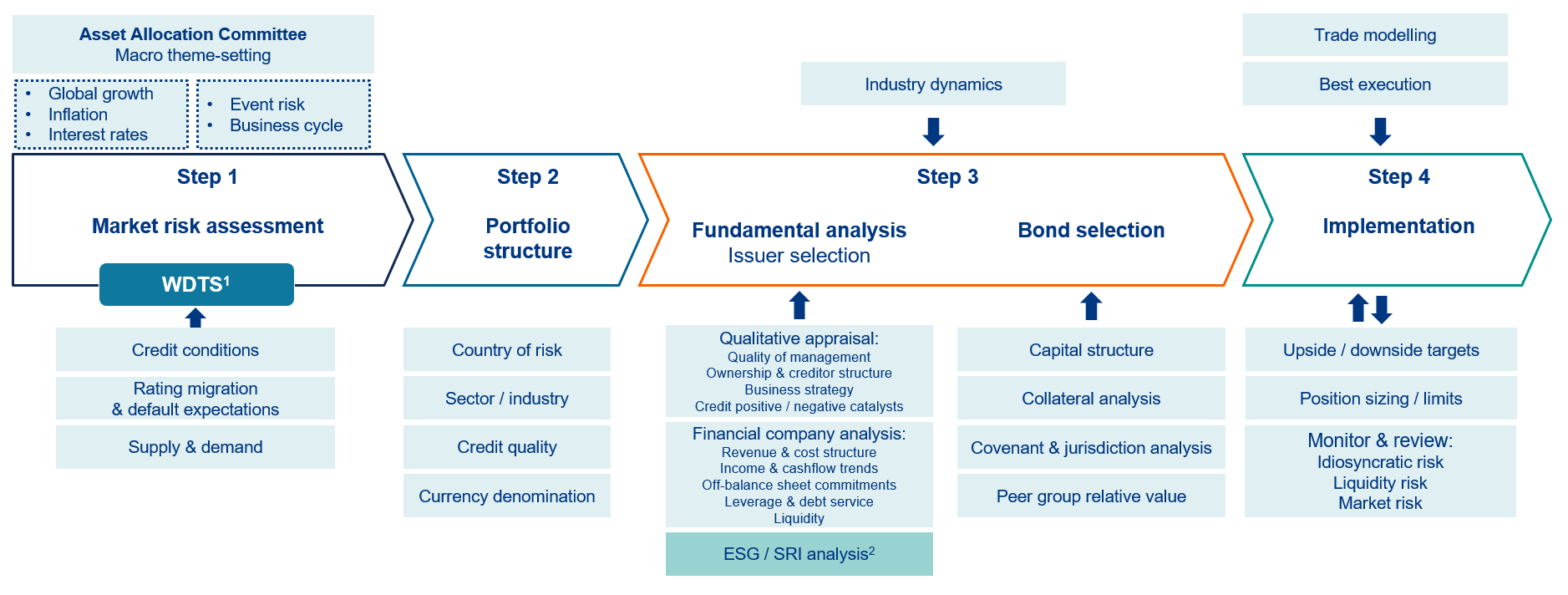
Source Allianz Global Investors, 2026. 1 WDTS (Weighted Duration Times Spread) is a key metric of credit risk. 2 Allianz Global Investors minimum sustainable exclusions are applied to the investment universe, visit Sustainable Investment Exclusions Policy (https://regulatory.allianzgi.com/en/esg) for more details. ESG: Environmental, Social and Governance. SRI: Socially Responsible Investing. The diagrams and statements above reflect the typical investment process applied to this Fund. At any given time other criteria may affect the investment process. There is no guarantee that these investment strategies and processes will be effective under all market conditions and investors should evaluate their ability to invest for a long-term based on their individual risk profile especially during periods of downturn in the market.
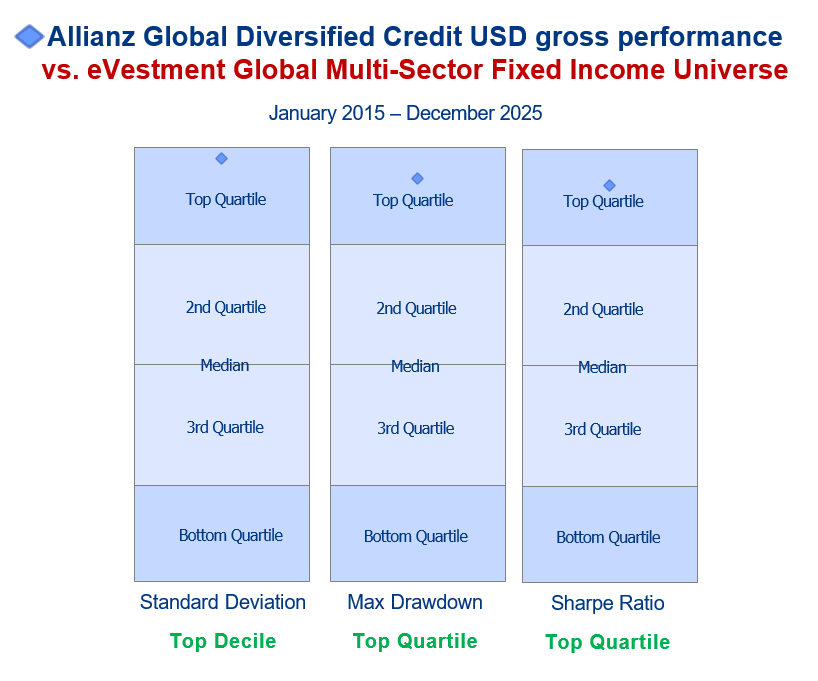
Targets income generation while integrating risk management measures to help manage downside outcomes.
- Seeks regular income generation
- Emphasis on:
- drawdown control
- capital preservation - Integrated risk controls in portfolio construction
Supported by a global research platform with integrated credit expertise
- Access to AllianzGI’s global credit research network
- Integrated teams across:
- regions
- sectors
- asset classes - Consistent credit underwriting process
Unconstrained by traditional benchmarks, enabling allocation to evolving opportunities.
- Not tied to traditional benchmarks
- Can allocate opportunistically across credit markets
- Able to respond to:
- dislocations
- refinancing cycles
- valuation shifts - Designed for changing rate regimes and credit cycles
Positioned to navigate higher-rate and more volatile credit markets.
- Benefits from elevated yields post-rate reset
- Seeks to capture spread dispersion and refinancing opportunities
- Built as an “all-weather” credit allocation solution
Allianz Global Diversified Credit: Allocating portfolio risk actively
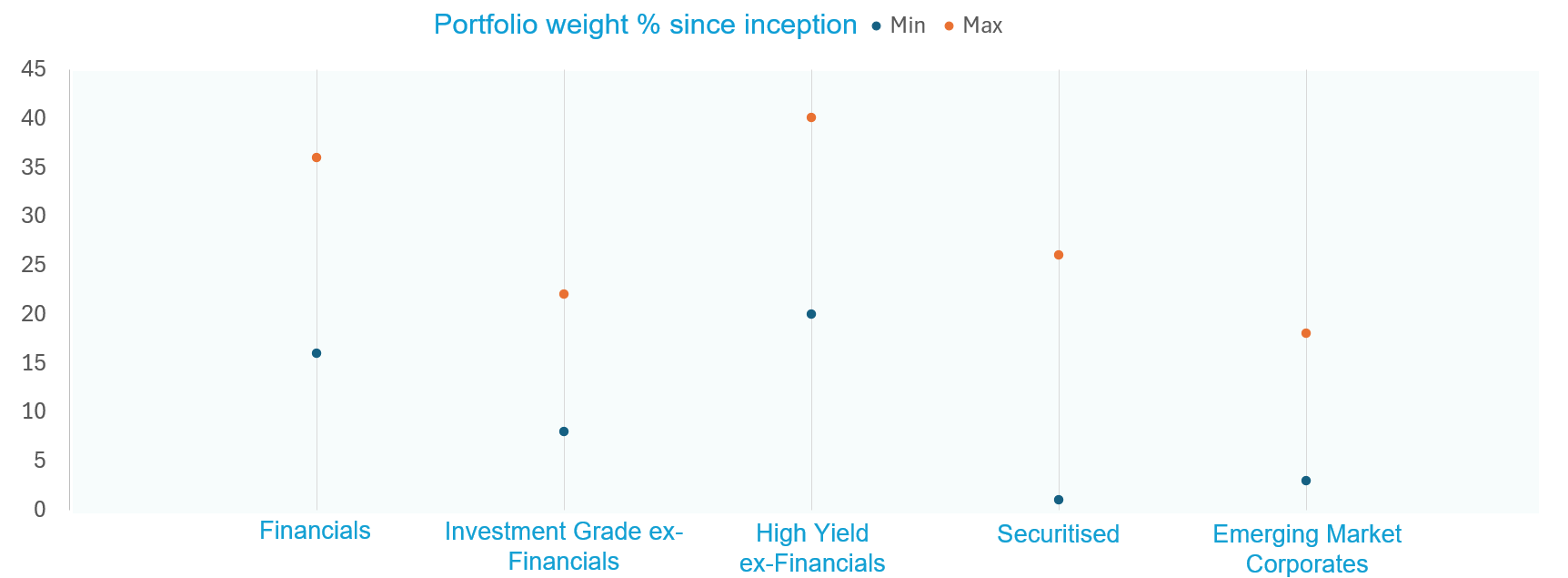
Source: Allianz Global Investors, IDS GmbH - Analysis and Reporting Services (IDS), IDS Portfolio Information Cockpit, 31 December 2025. Please note that this report may be based on manual data uploads and calculations. The methodologies and data sources used may be different from the sources used for official fund documents. This report has been created to the best of our knowledge, effort and available data and is assumed to be correct and reliable at the time of publication. This report has not been externally verified. Please refer to the mandatory periodic statements/reports which are solely binding. All percentage data are market-value-weighted. Percentage figures plotted on the bar chart have been rounded to the nearest whole number. This is for guidance only and not indicative of future allocation.
Investment Approach
1. Market risk assessment
Macro analysis informs risk allocation and positioning
2. Portfolio construction
Exposure across sectors, regions and ratings
3. Security selection
Fundamental issuer research and credit analysis
4. Implementation and monitoring
Ongoing review, position sizing and risk control
Frequently Asked Questions
In our view, GDC's relatively short duration, broad diversification across credit markets and spread income potential may support a consistent income profile. These characteristics may also help moderate interestrate sensitivity compared with longer-duration government bond strategies. In addition, the Fund’s diversified sources of return may result in different performance patterns to some more narrowly focused benchmarked income strategies, which could complement existing income-focused portfolios.
Recent years have seen several unforeseen events that have impacted regions, industry sectors, and individual companies rapidly and differently. We believe it makes sense to have the broadest opportunity set, to allow a manager to react quickly to evolving trends in global markets. With portfolio managers and credit analysts based across the globe, we challenge and co-ordinate the views of our global and regional specialists, aiming to generate the best risk adjusted returns.
Credit sectors behave differently depending on where we are in the interest rates and credit cycles and returns are not overly correlated.
Our process begins with a top-down view on global growth and the impact on interest rates and credit and we then allocate capital to where we expect to see the best risk adjusted returns. We regularly test our assumptions and change capital allocations when needed. A single sector asset class is more homogenous and captive to its specific drivers.
The Fund is credit focused and is likely to underperform government bond focused income strategies when government bonds rally and credit sell off. We can hedge credit risk and reduce drawdowns.
With every credit strategy there is default risk. We aim to mitigate this via considered security selection and position sizing scaled to potential risk. Since inception, we have not had a single name credit loss that has exceeded our position sizing framework that aims to ensure that no single credit position costs the portfolio more than 40bp.
Credit strategies are less liquid than government bond strategies. We mitigate this by focusing on liquid public credit markets and having internal rules on issue size and position concentrations. Since inception, we have met every flow on time without the need for liquidity facilities or materially changing the portfolio structure.
The fund is SFDR with a best-in-class approach. There are two binding elements. The first is AllianzGI’s minimum sustainable exclusion list. The second utilises our internal ESG scores, with 70% of the fund need to be rated and of these 80% must meet our best-in-class threshold. We also monitor carbon, SDG and Taxonomy alignment. A full sustainability report is available, https://uk.allianzgi.com/en-gb/institutional/sustainability/sustainability-report-2025
* Allianz Global Diversified Credit Fund has been classified as an Article 8 under SFDR: EU Sustainable Finance Disclosure Regulation. Information accurate at time of publishing. Investors should take into account all the characteristics and/ or objectives of the fund as described in its prospectus and KIID (regulatory.allianzgi.com)
The fund uses derivatives parsimoniously, primarily for FX hedging. It actively avoids building inherent leverage and/or unnecessary bilateral counterparty risk that typically come from excessive and/or superfluous use of derivatives. We believe our clients pay us to trudge the hard path of making bottoms-up, idiosyncratic credit risk choices rather than walk the easy path of taking top-down, index-level risk (via total return swaps or credit default swaps).



Find out more
|
Document
|
Date
|
Actions
|
|---|---|---|
|
|
|
|
|
|
|
|
|
|
|
|
|
|
|
ADM: 5965159